Rural Health and Drinking Water
FREE arsenic testing for private wells in southern Minnesota

Freshwater and the Mayo Clinic, are partnering to test private drinking water wells for arsenic in eight southern Minnesota counties (Rice, Steele, Freeborn, Waseca, Faribault, Blue Earth, Watonwan, and Martin). This project approaches well testing with a new lens by partnering with healthcare physicians to educate and encourage residents to test their wells – and by offering free, convenient well testing opportunities.
Arsenic is an element found in rocks and soil across Minnesota. When dissolved into groundwater, arsenic can impact the safety of drinking water and can increase the risk of cancer and other health concerns such as cardiovascular and respiratory disease, reduced intelligence in children, and skin problems. A key objective is to educate both private well users and the Mayo Clinic healthcare providers who frequently diagnose and treat preventable diseases linked to chronic arsenic exposure.
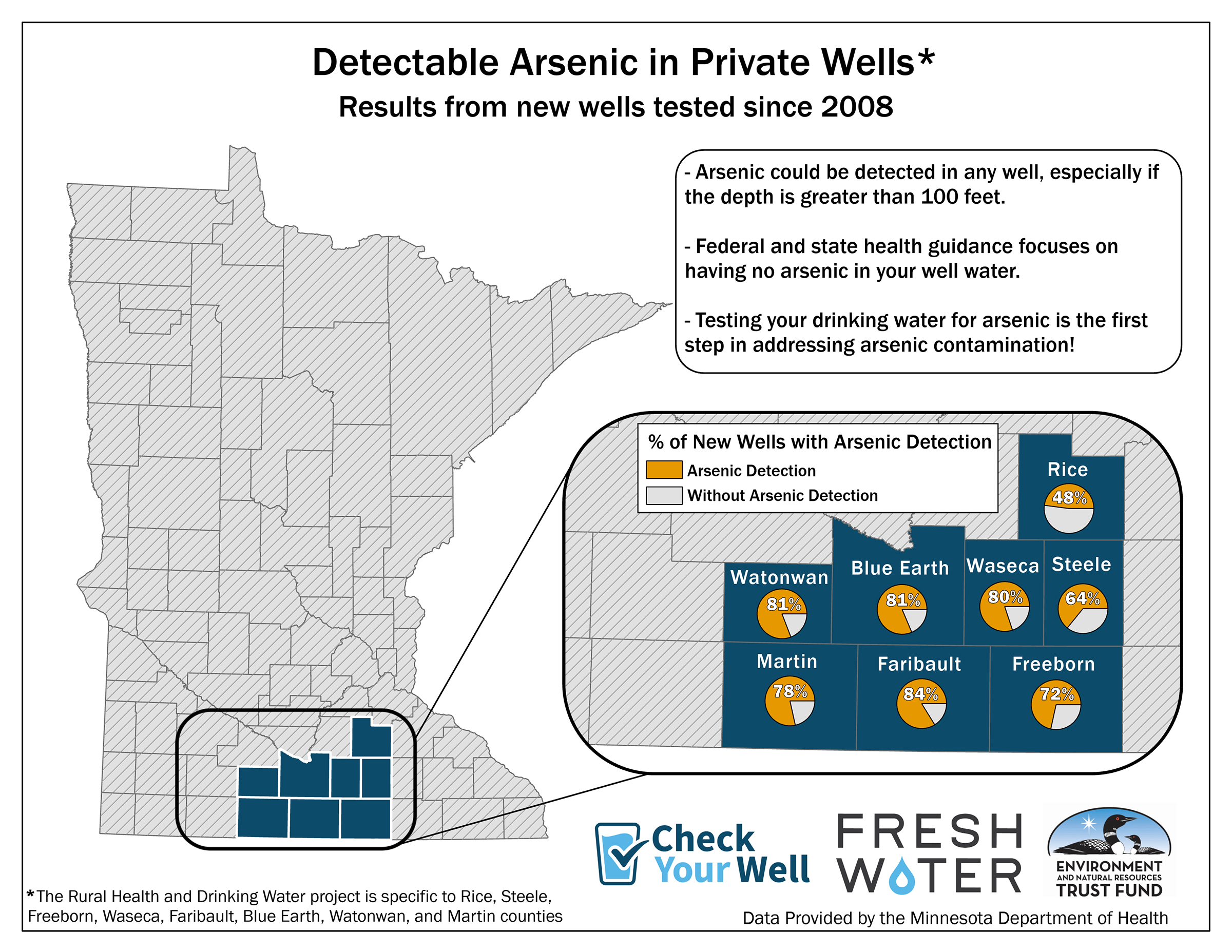
The map below indicates the prevalence of detectable arsenic within the project area.
Detectable Arsenic in Private Wells
FREE Arsenic Testing Kits - Available Online

- All materials shipped directly to your door.
- Includes prepaid shipping both ways.
- Reliable, certified lab results.
- Easy to follow instructions and guidance.
- Confidential results will be emailed to you.
This project applies to residents of Rice, Steele, Freeborn, Waseca, Faribault, Blue Earth, Watonwan, and Martin counties. If you have a well, the only way to know if your water is safe is to test it.
- About 10 percent of private wells in Minnesota have elevated arsenic.
- The prevalence of wells with detectable arsenic in southern Minnesota counties ranges from 48 to 84 percent as shown in this map.
- Arsenic is odorless and tasteless – only laboratory testing can detect it.
- Arsenic builds up in the body over time.
- Arsenic can cause serious health problems in children, adults and pets.
- Long-term exposure increases the risk of:
- Certain cancers (skin, bladder, lung, liver, kidney and prostate)
- Heart and lung disease
- Nervous system and organ damage
- Weakened immune system
- Developmental impacts (such as low IQ) in children
- Growth disruption in children
- Premature birth or pregnancy loss
Learn more about private wells (Minnesota Water Resources Center)



“Clean drinking water is something everyone deserves. This project helps Minnesota families find out if their well water is safe and gives them simple steps to protect their health. I’m proud to be part of this effort to make testing easier and raise awareness about the risks of arsenic in well water.”
- Dr. Dominika Jegen, M.D.,
family physician with Mayo Clinic and project partner
Funding for this project was provided by the Minnesota Environment and Natural Resources Trust Fund as recommended by the Legislative-Citizen Commission on Minnesota Resources (LCCMR). The Trust Fund is a permanent fund constitutionally established by the citizens of Minnesota to assist in the protection, conservation, preservation, and enhancement of the state’s air, water, land, fish, wildlife, and other natural resources.
For more information about this project, please reach out to Chyann Mosey.